

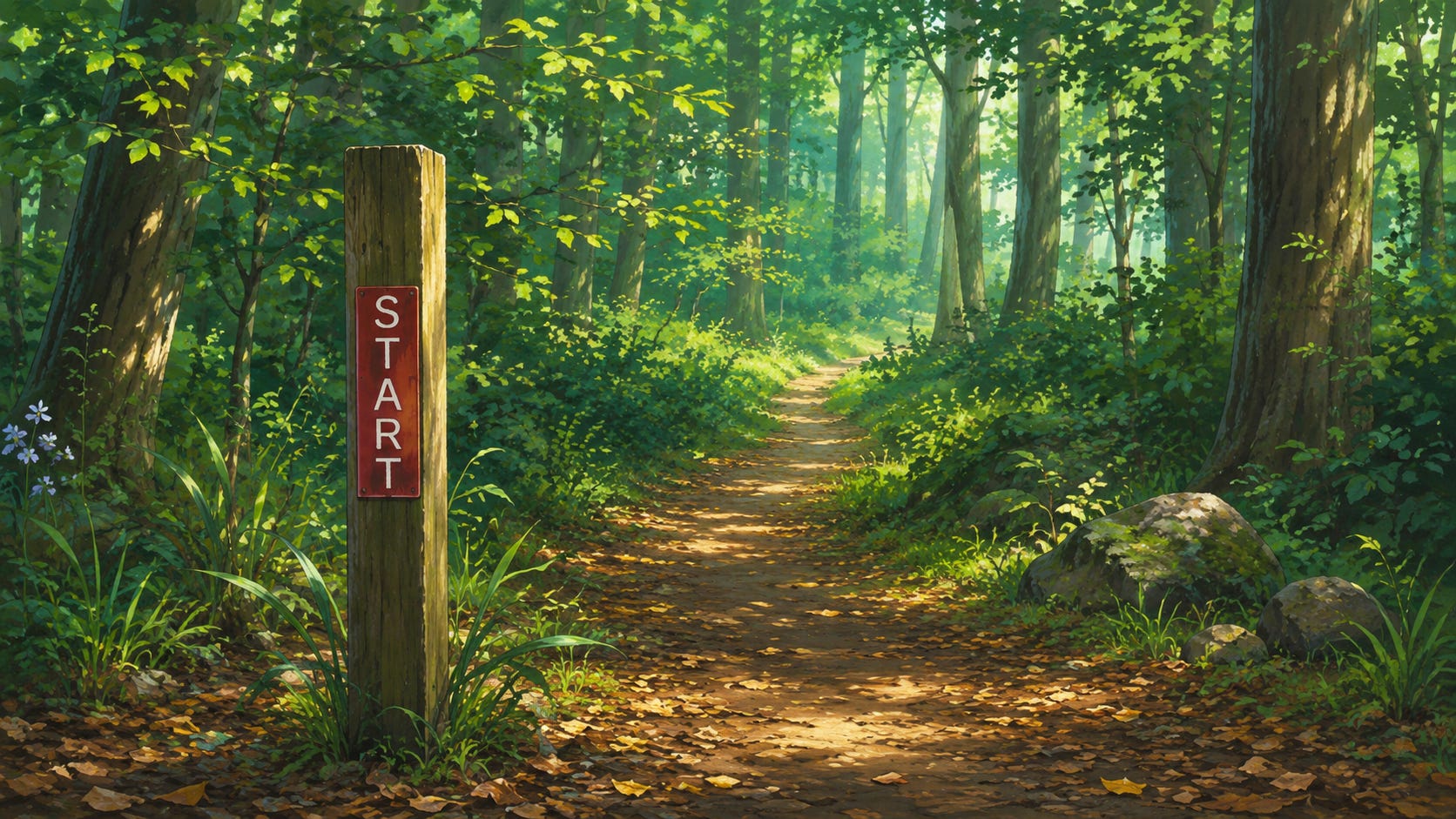
I have a hard time starting personal projects. A lot of people I know struggle here and based on some cursory research it’s a pretty common struggle.
This month I decided to start painting again. It’s a hobby I love but I’ve managed to put it off for a few years. Even after committing to it, I debated backing out before my first painting. I had a lot of anxiety about how rusty I’ve become and whether or not I really have time for it.
I also decided to start on some landscaping projects that I’ve been putting off for about two years. I felt a little more sure about this one but I’ve put it off for so long due to lack of planning and time concerns.
These both represent common shapes of the problem for me.
Why is it hard?
Starting requires a change in state.
You need to go from not doing to doing. Seems obvious but there’s a lot buried in there.
It’s easy to keep things as they are and people tend to be resistant to change, especially large change. Starting is change. You have to context switch and build momentum from nothing.
I was resisting getting started with painting this month. It was mostly about the cost of getting started. I had to dig through some boxes and find my paints and brushes. I had to clear off a desk to use it for painting. I had to set up some lighting so I could see what I was doing. I had to actually set aside time to do it.
But then, once you get past the initial speed bump it’s natural to keep going because, again, we are resistant to change. Stopping also has a cost.

You must cut through ambiguity.
Before you start, it feels like a ton of work because you don’t really see the specifics.
We often think in terms of broad, non-specific activities. I wanted to start “painting” again. I wanted to “do my landscaping projects.” You see some ambiguous idea of an action and that can be anything.
Getting started means getting specific. And that is work. You have to decide exactly what you’re doing and not doing. You have to figure out how you’re going to do it.
Once you actually get specific you can bread down the task into simple steps. Take some shovels of dirt and move them over there. Take some paint and put it on that paper.
Ideas can feel perfect. Reality can not.
Behind the other two is the painful reality of, well, reality.
In our minds we can dream up whatever we want. My landscaping projects can be like the Hanging Gardens of Babylon. My paintings can be like the melding of Andrew Wyeth and J. M. W. Turner. Yea, reality isn’t like that.
This kind of compounds with the other two. As we dream of all the ways our work can be perfect, we make starting even harder. The idea becomes larger and more ambiguous. The cost of starting becomes harder to pay.
So, it’s easy to fall into a state of dreaming about something you’ll do and then never actually doing anything.
What can we do about it?
Realize the problem is a feeling and not a reality.
The biggest hurdle to getting started is the feeling that getting started is hard. That’s what we’re trying to address. That feeling can be totally overwhelming in some cases.
But, with this in mind and a few tricks you can make almost anything easier to begin.
Make the first step stupidly small.
There’s a pretty common trick called the “5-minute rule.” Not sure where this comes from but the idea is if you are having trouble starting something, just commit to five minutes of doing it.
This is kind of a hack for picking something small enough that you can do it in five minutes. It might work for you, but I’ve personally never found this time approach that useful. Instead I prefer to directly choose something specific and tiny.
Part of my landscaping project involves moving about 37 yards of dirt from this huge raised bed to some other places in my yard where concrete was removed. I put this off for whole years now. To start I simplified this to just go take a single shovel of dirt and move it where it needs to go about 10 feet away. Now I’m slowly making progress on the project (though I did end up getting an excavator).

Lower the stakes.
Since we like to dream big, we tend to raise the stakes of the outcome. This creates a lot of psychological baggage that keeps us from getting going.
Instead of focusing on some perfect finished product, you can focus on some simple low-stakes intermediate product. Or, just lower the target and plan to improve over time.
For my watercolor paintings I decided to do them in a sketchbook for a specific reason. If I make them individual pieces on individual pieces of paper then I feel like each one could be “a work of art.” But, I’m not trying to make works of art. I’m trying to practice painting and relax.
Putting them in a sketchbook lets me focus on filling the sketchbook instead of creating individual meaningful pieces. Now, I can hear some voice saying “but what if you mess up a page?” I can see how that would bother many people. It might even bother me, but my goal is to fill it and a messed up page gets me there. You have to find ways lower the stakes that work for you and your own peculiarities.
Make a commitment.
You need to actually commit to the thing you want to start. This may sound like it could make things harder. And yet, I’ve found this to clear one of my biggest hang ups.
I have all these things I want to do. But, when they happen can be just as ambiguous as what is going to happen.
For example, I put off these landscaping projects for years. This wasn’t because they are particularly insurmountable but because I never committed the time to do them. I could move some stones around one weekend. Do a little design a couple weeks after that. Then, suddenly it’s a few months later, and I’m doing some research and planning.
No, that’s not working.
Right now I’m actively choosing monthly things to focus on. This month, landscape painting and landscaping. Next month, we’ll see (but probably going to involve more landscaping).
It requires deciding both what will be the focus for now, but also what will be pushed off for later.

Give yourself an exit.
Again, part of the ambiguity is around time. Is this thing going to go on forever? How long will it take?
We address this by making the steps smaller, getting specific, and lowering the stakes. But then there’s still this still this fear of commitment to something new.
It’s always good to have an exit plan. It’s the other side of bounding goals.
I’m committing to painting 30 paintings this month. That won’t even fill my sketchbook. But, if I feel like it I’ll keep going next month or in the future. It doesn’t have to happen now. For my landscaping projects I have a couple milestones that I’m trying to hit this month but if it’s not going well I’m willing to eject and hire people.
We need to design around our emotions.
It’s tempting to think that getting past this problem is about willpower. Suck it up. Just make yourself do it. But, I don’t think that’s the real solution. I don’t even think that’s very productive.
Even if you pull off some force of will, you might end up making yourself hate something you could otherwise love.
The real solution feels more like a design problem. We need to focus on the right problem, the feeling, and then address it thoughtfully. We have to create rules and context for ourselves that’ll make the feeling of starting more positive and less negative.
It’s less about force and more about care.
Amen!! I stumbled across this article as I’m doing something new that I’ve never done before (drawing in public at the airport). So it helped. Thanks!
"It’s easy to keep things as they are and people tend to be resistant to change, especially large change. Starting is change. You have to context switch and build momentum from nothing."
Hit the nail on the head with this and most people would rather avoid starting than actually just beginning. Sometimes it is better to wait to start when you are "ready" to; however, that day may never come if you keep putting it off "for a rainy day."
For me, I just charge into it headfirst because, otherwise? I might never start...fighting my mind and myself is my own, personal battle. Guess what, though? As soon as I begin, I instantly feel better. That's just me.
Great read and glad you are venturing back into other creative outlets, be it painting, landscaping, etc. Do it when ya feel the inspiration or simply do it when ya bored. Post on. Reading in the shadows...